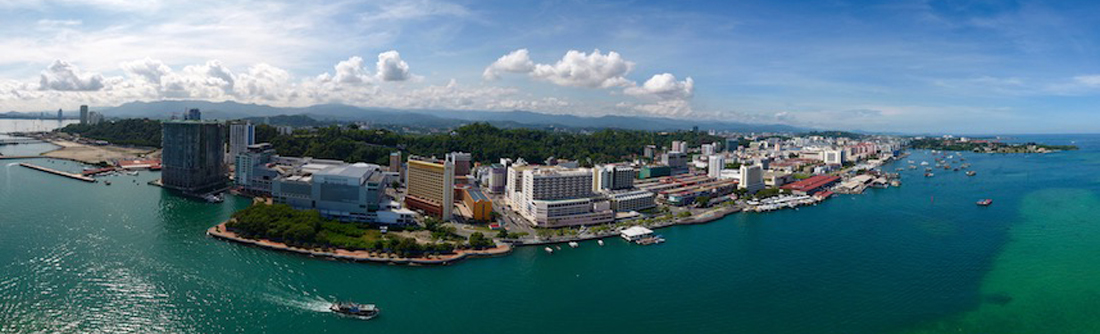
Kota Kinabalu is the sixth-largest city in Malaysia and the state capital of Sabah. It was officially granted city status on February 2, 2000. Prior to the formation of Malaysia, it was known as Jesselton, named after Sir Charles Jessel, the Vice-Chairman of the British North Borneo Chartered Company. Domestically and internationally, the city is frequently referred to as “KK,” while locals often call it “Api-Api.”
Situated on the northwest coast of Borneo facing the South China Sea, Kota Kinabalu is flanked by the famous Tunku Abdul Rahman Park to its west and Mount Kinabalu to its east. The city has a population of approximately 452,058, which grows to roughly 628,725 when including the greater metropolitan area of Penampang.
As a thriving hub for fisheries and tourism in Sabah and Borneo, as well as a major industrial and commercial center for East Malaysia, Kota Kinabalu has become one of the fastest-growing cities in the country.
The Kota Kinabalu Community Hall remains the primary venue for hosting major basketball tournaments.
Kota Kinabalu is the third and current capital of Sabah. The name “Api-Api” (the root of “亚庇” or Yà bì in Chinese) is said to mean “Fire” in Malay. Historically, the city suffered several major fires, leading to its nickname, “The City of Fire.” In the Hakka dialect, the pronunciation of “Ah Bi” sounds identical to the Malay word “Api,” which is why locals continue to use this name to this day.
Following independence and as part of decolonization efforts, the name was changed to Kota Kinabalu. In Malay, Kota means “City,” and Kinabalu refers to the sacred Mount Kinabalu—collectively meaning “The City of Kinabalu.”
Early Chinese settlers also referred to the area as Api-Api, originating from an early fishing village. While some believe it meant “Fire,” others point to the meaning of “fireflies.” This name remains widely used by Sabahans and international airlines. Outside of Sabah, the city was once commonly translated as “Geda Jingnabalu,” but after the establishment of the Malaysian Chinese Language Standardization Council, the official Chinese name was finalized as “亚庇” (Ya Bi) to honor the preferences and heritage of the local people.
On September 30, 1968, Jesselton was officially renamed Kota Kinabalu. Today, the city stands in the majestic shadow of Mount Kinabalu, the highest peak in Southeast Asia at 4,095.2 meters (13,435 feet).
Current estimates suggest that Kota Kinabalu and its surrounding townships have a population of approximately 1 million people. This demographic includes roughly 500,000 Chinese, 350,000 Kadazans, 50,000 Malays, and 100,000 from other ethnic groups.